
Environmental DNA to Monitor Freshwater & Marine Biodiversity
Learn how environmental DNA can support biodiversity monitoring and its different applications.
Table of Content
Why is Biodiversity Loss a Concern?
Biodiversity encompasses all species, plants, organisms and ecosystems on Earth. Humans rely on healthy biodiversity in freshwater and marine environments for our well-being and livelihood. Habitat destruction, pollution, climate change, invasive species, natural resource exploitation and unsustainable agricultural practices are threatening biodiversity and Life Below Water (SDG 14). Often interacting and amplifying one another, they pose significant challenges for conserving biodiversity and maintaining the health and functionality of ecosystems.
How to Protect Freshwater and Marine Biodiversity
To implement effective conservation strategies and measure their impacts, researchers and decision makers need reliable scientific data to understand how biodiversity loss affects different ecosystems. This requires the ability to capture and analyze sufficient field data that is often challenging to obtain.
Traditional methods for capturing freshwater and biodiversity data, like species capturing, trapping, netting, and imaging, can be outdated and ineffective. They are often destructive, require manual counting, measuring or dissecting, and fail to detect elusive species.
Environmental DNA offers a more efficient and cost-effective method of monitoring biodiversity.
Environmental DNA for Monitoring Freshwater and Marine Biodiversity
By collecting and analyzing the DNA shed by aquatic and marine animals, specific species or general community assessments can be provided without disturbing any animals or their habitats.
Collecting eDNA involves filtering water samples in the environment. The DNA captured on the filters is then extracted, amplified and analyzed to match the genetic material to a reference database of known animal species. The full process is called metabarcoding or metagenomics, depending on the method used.
Environmental DNA is an efficient method to detect at-risk, elusive and endangered species, pathogens and parasites; provide general biodiversity snapshots from apex predators to tiny organisms; support environmental impact assessments; estimate fish community dynamics; and measure water quality and health.
Conservation Applications for Environmental DNA
Environmental DNA has a variety of applications for biodiversity monitoring, including:
- General biodiversity assessments
- Invasive species detection
- Environmental impact compliance and reporting
- Endangered, at-risk and cryptic species tracking
- Water quality assessments
- Restoration monitoring
- Early detection of pathogens and parasites
- Citizen science and education
Collecting eDNA Samples in Freshwater and Marine Environments
Previously, the tools used to collect eDNA field samples required manual and time-consuming processes that leave samples susceptible to contamination.
To overcome these challenges, Ocean Diagnostics has developed innovative surface and depth sampling technologies to advance eDNA sample collection in freshwater and marine environments.
Collecting eDNA Samples at Depth
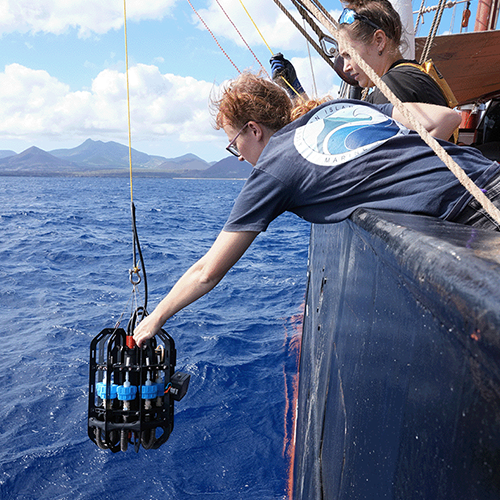
Ascension is an automated, portable and rechargeable depth sampler that collects eDNA from the side of any small vessel or fixed installation like a buoy, dock or AUV/ROV down to 400 meters. It filters the samples directly in situ, avoiding manual and time-consuming processes and sample contamination risks.
Equipped with onboard sensors, Ascension tracks and stores conductivity, temperature, depth, salinity, flow rate, filtration volume and GPS in real time. It is suitable for freshwater, coastal marine, offshore and estuary environments.
It is actively used by researchers, conservation organizations and governments around the world. Its ease of use, portability and in situ filtration capabilities support users to collect data that is otherwise challenging or impossible to obtain.
Collecting eDNA surface samples
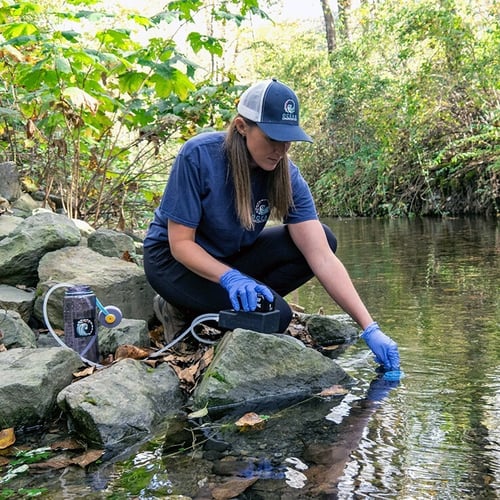
Ocean Diagnostics’ eDNA Surface Sampler is a small, hand-held vacuum pump that collects eDNA from surface water in aquatic and marine environments, including lakes, rivers, streams, creeks, wetlands, estuaries and oceans.
Like the depth sampler, it also filters the samples directly in situ, avoiding manual and time-consuming processes and sample contamination risks.
It is actively used by researchers, conservation organizations and governments around the world. Its simplicity and portability streamline the eDNA sampling process, especially in remote and rugged locations.
Summary
Environmental DNA is a promising method for monitoring and conserving freshwater and marine biodiversity. While some eDNA sampling equipment is outdated or inaccessible in remote locations or at depth, Ocean Diagnostics’ automated depth and surface sampling technologies are cost-effective, versatile and scalable, enabling efficient and reliable eDNA sample collection in even the most remote locations.
With more accessible data, researchers, governments, industry and conservation organizations can efficiently assess, monitor and protect biodiversity.