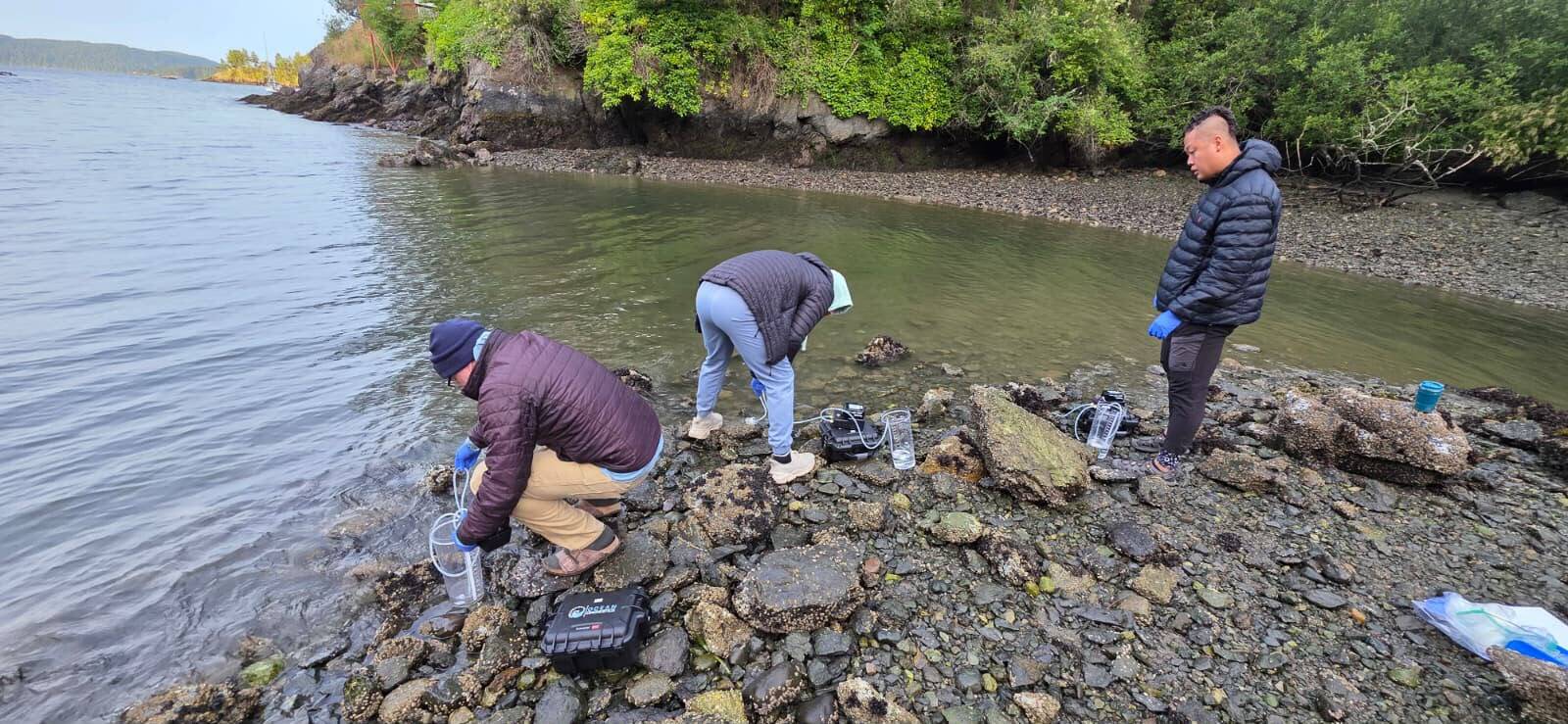
With expertise in both field sampling and analytical methods, including qPCR, nanopore sequencing, environmental RNA and epigenetics, Dr. Ip is a proponent of using eDNA for a variety of applications. His personal mission is to introduce a One-Health framework to expand environmental sampling beyond species and into public health, while working with partners across the Global South on capacity building and data sovereignty.
We sat down to learn about his experience with Discovery, the first of Ocean Diagnostics’ two eDNA surface samplers, and his future research plans with the technology.
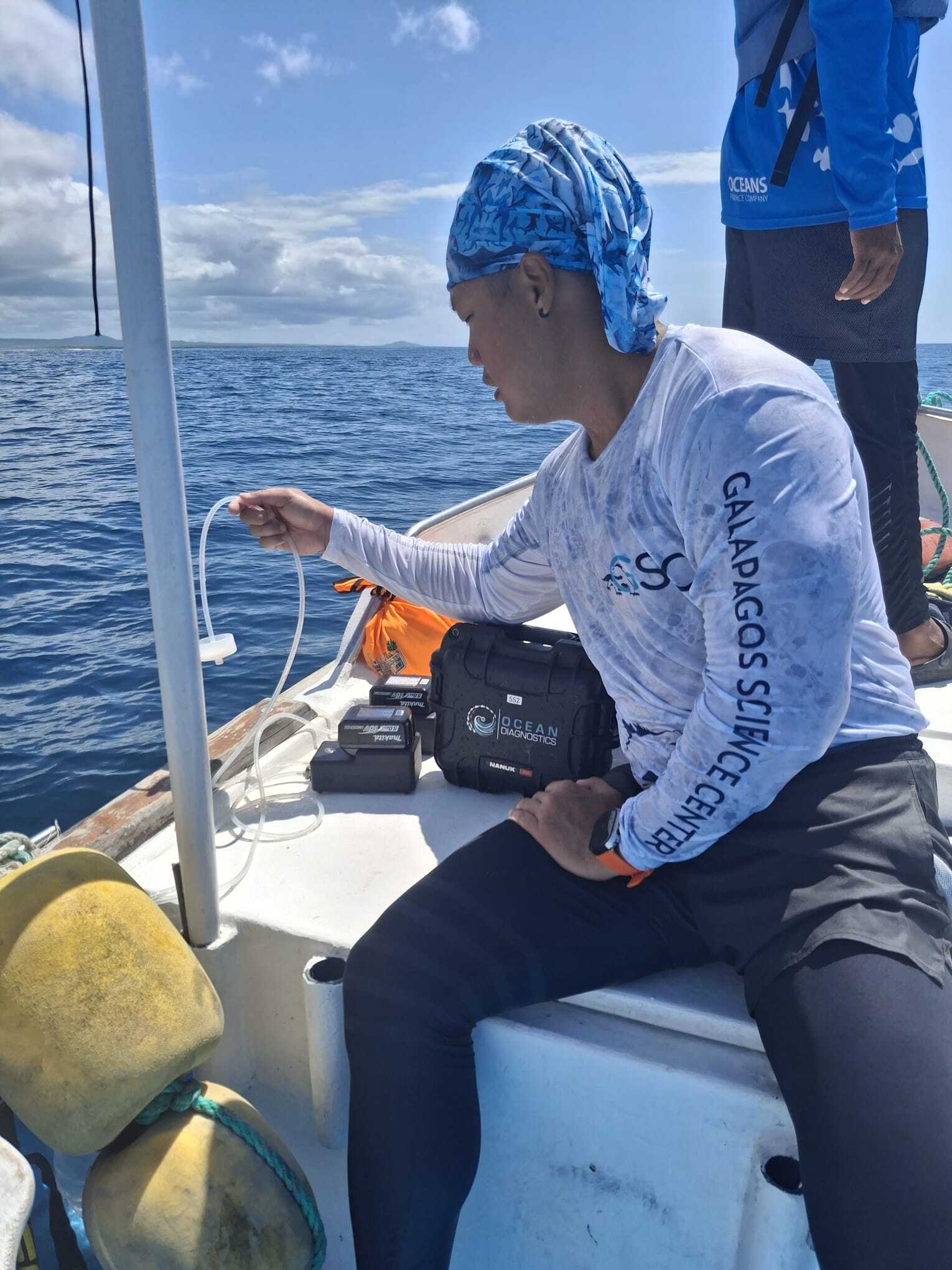 Photo above using Discovery directly from the side of a small boat to collect eDNA water samples. Photo provided by Dr. Aden Ip.
How have you collected eDNA water samples in the past?
The first environment that I worked on was a coral reef in Singapore over a decade ago, and it was so old school. I was just using a Van Dorn horizontal sampler. I’d trigger it at depth, bring it up and do the manual filtration onboard, which is painful and prone to contamination. It amazes me how things are so compact and sterile now. Everything is isolated, so we can do eDNA sampling with much higher confidence and efficiency.
What’s the biggest challenge in collecting eDNA water samples?
Aside from contamination, the main challenge is compounding logistics. There is so much gear for eDNA field work, even just to collect one to two litres of water. With the Discovery eDNA Surface Sampler, I can just walk along the coastline and sample. It’s so much easier. I could literally put that little pump in a designer handbag with just some filters. It’s a clean, closed system, so you’re not dealing with spills or splashes the way you would with open filtration.
That would certainly be the most stylish field sampling we’ve seen! How are you using the Discovery eDNA Surface Sampler in your work?
Right now, I am working with Universidad San Francisco de Quito in the Galápagos—a very biodiverse region—on a trial manta ray project. They have three Discovery eDNA Surface Samplers they are very happy with, and they’re moving on to whale detection and freshwater and terrestrial sampling to map giant tortoise distribution.
They deployed them off the side of a boat and used them for diver subtidal sampling where divers brought packets of water back to filter on board using Discovery. The power lasted a really long time. They were on a week-long cruise, and the battery pack lasted throughout the whole cruise, which is amazing.
They took 20 or 30 samples at around 20-35-litre filtration volumes per sample with 5-micron pore size filters. The water was clear, but there was a lot of plankton, and it still went through (the Sampler) well. I also recently just went to the Maldives where we will be using the Sampler with the Maldives Resilient Reefs to build capacity for monitoring threatened shark species.
Which applications would you say are best suited for the Discovery eDNA Surface Sampler?
The first use case would be for people who are just getting their feet wet with eDNA sampling. The Sampler is super easy to use, and it's not too intimidating in terms of logistics.
The second use is for places with no lab infrastructure. Somewhere you have a small boat, no bench, no main power and a long trip back. The Sampler travels well and does not need much around it, so it opens up sites that used to be out of reach. Not because the habitats were unusual, but because the logistics were. That matters for the kind of work I’m doing: conservation monitoring with local groups and, on my own side, environmental epigenetics.
Because the Sampler takes up so little space and time, I have extra room in my bag and time in the day for other things like eRNA sampling, age estimation and pathogen work. Less time spent on filtration logistics means more time doing actual lab work and field analysis.
What’s on the horizon for your work with the Discovery eDNA Sampler?
I'm big on data sovereignty, capacity building and real-time monitoring. So, in that kind of theme, the eDNA Surface Sampler is the first piece of the jigsaw puzzle that can make this happen.
It’s a piece that fits really well into my workflow. I'm trying to compress the sample-to-results time as much as possible. Hopefully, I’ll be able to push this whole workflow in more extreme environments and get a faster turnaround in terms of results for more people around the world, too.
...
Order your Discovery eDNA Surface Sampler here, or explore all of Ocean Diagnostics' eDNA sampling technologies here